


DIC Module
Two Differential Interference Contrast (DIC) Modules are available from Navitar for the Zoom 6000 and 12X Zoom systems.
- DIC Assembly Nikon - High Resolution Module (1-63726)
- Original DIC Assembly Module (1-63102)
Both modules can be used on any ultra-coax version (zoom or non-zoom) of the Zoom 6000 and 12X Zoom.
DIC, when used with brightfield illumination, can often be interpreted as a true three-dimensional representation of the surface geometry. It provides a clear distinction between raised and lowered regions in the specimen being viewed.
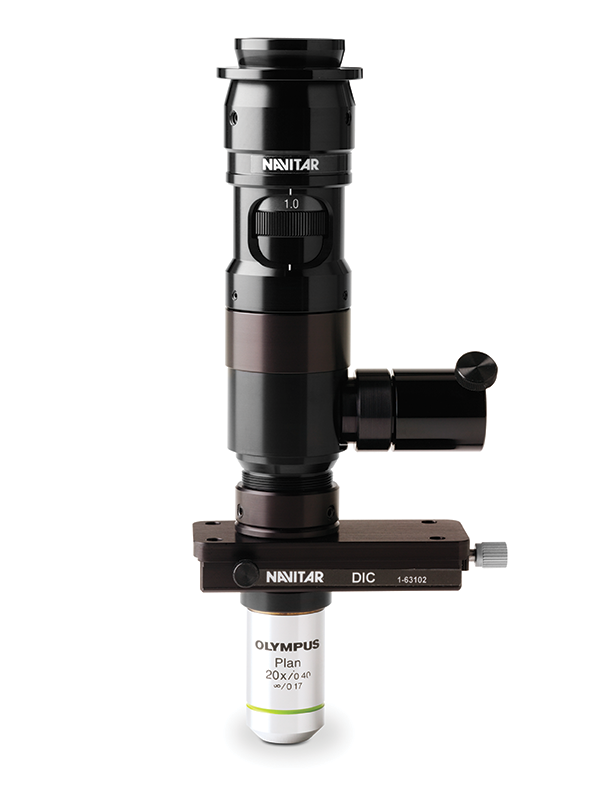
-
Using the DIC Module
-
DIC with Zoom 6000
-
Downloads
Using the DIC module in reflected light situations
Two polarizers, one in the illumination axis and one in the viewing axis, are crossed at 90 degrees such that when looking at a perfectly mirrored surface all light is extinguished by the second polarizer.
A prism, made from two pieces of quartz, is then placed between the illuminator beamsplitter and the objective. Due to the optical properties of the quartz, the polarized beam is split into two. The two beams, separated by a minuscule amount, are polarized at 90 degrees to each other and one beam is shifted in relation to the other, a phase shift. If the subject being viewed exhibits properties that change the length of the optical path of either beam (such as surface profiles, optical densities, etc.), both beams will experience further phase shifts.
With transverse movement of the prism the phase shifting performance of the prism may be accentuated and the final image is modified. By adding a polarization modifier, such as a 1/4 wave plate, after the illumination polarizer, the final effects are modified further.
The DIC module works with object side NAs ranging from 0.05 to 0.50, with optimum performance in the range from 0.15 to 0.4. Lens attachments, operating in the above range will serve for macro applications. Any infinity corrected objectives designed for incident light will suffice for micro applications. Operating parameters, such as magnification and FOV, will be the same as Navitar’s existing tables for the zoom system being used.
Two polarizers, one in the illumination axis and one in the viewing axis, are crossed at 90 degrees such that when looking at a perfectly mirrored surface all light is extinguished by the second polarizer.
A prism, made from two pieces of quartz, is then placed between the illuminator beamsplitter and the objective. Due to the optical properties of the quartz, the polarized beam is split into two. The two beams, separated by a minuscule amount, are polarized at 90 degrees to each other and one beam is shifted in relation to the other, a phase shift. If the subject being viewed exhibits properties that change the length of the optical path of either beam (such as surface profiles, optical densities, etc.), both beams will experience further phase shifts.
With transverse movement of the prism the phase shifting performance of the prism may be accentuated and the final image is modified. By adding a polarization modifier, such as a 1/4 wave plate, after the illumination polarizer, the final effects are modified further.
The DIC module works with object side NAs ranging from 0.05 to 0.50, with optimum performance in the range from 0.15 to 0.4. Lens attachments, operating in the above range will serve for macro applications. Any infinity corrected objectives designed for incident light will suffice for micro applications. Operating parameters, such as magnification and FOV, will be the same as Navitar’s existing tables for the zoom system being used.
3D Topography of Flat Panel Display Circuit Highlighted by Employing Differential Interference Contrast (DIC) and the Zoom 6000


Have any questions?
Speak to a member of our team today.